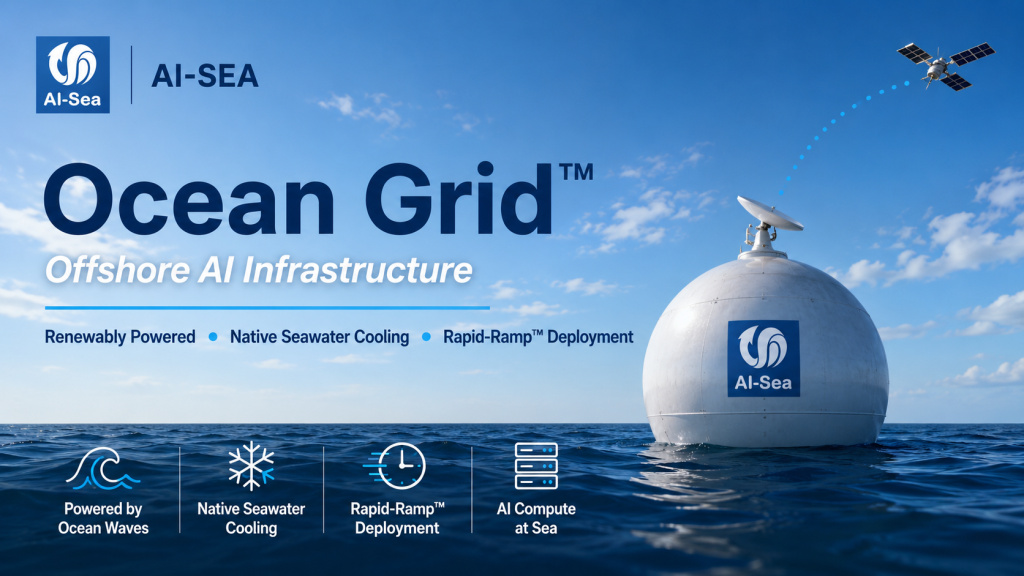
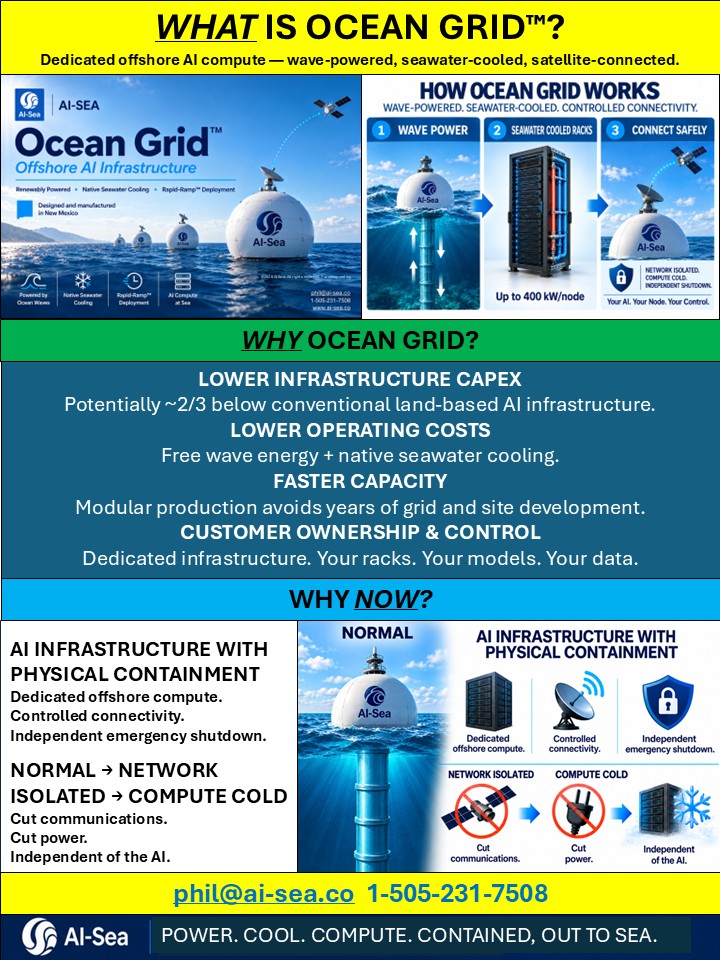
Grid-Independent AI Compute Powered by the Ocean
Ai-Sea deploys modular offshore data-center nodes driven by wave energy, delivering scalable AI capacity at lower lifetime cost compared to land-based data centers limited by grid power, cooling load, and permitting which constrain growth.

The problem
Global AI demand is accelerating faster than electric grids, transmission build-out, and data-center permitting.
Across major markets:
- Interconnection queues exceed 5–10 years
- Power availability—not chips—is the binding constraint
- Cooling limits cap density in warm regions
- Electricity price volatility threatens long-term compute economics
The result: AI growth is power-limited.
Ai-Sea moves compute to energy — not energy to compute.
Multi-node kW Balancing
Ai-Sea nodes operate in geographically distributed clusters, allowing wave and wind conditions at different locations to balance one another.
This multi-node architecture enables:
- Firm, utility-grade renewable power without grid dependence
- Higher uptime than single-site offshore systems
- Scalable megawatt-class deployment through modular expansion
Balancing across the ocean transforms variable marine energy into reliable compute power.

Keeping Costs Low – Production To Operation
Keeping Costs Low – Production to Operation
Ai-Sea is engineered for the lowest possible lifetime cost per rack-year, from fabrication through decades of offshore service.

Mix & Match Production Sites
Nodes can be manufactured across multiple global coastal facilities, enabling:
- Competitive labor and materials sourcing
- Parallel production scaling
- Reduced geopolitical and supply-chain risk
Distributed manufacturing supports rapid global deployment.

Building a Better “Boat” With Lifetime Materials
Fiberglass composite structures eliminate corrosion and minimize maintenance compared with steel marine systems.
Benefits include:
- Multi-decade service life
- Near-zero structural maintenance
- Lower lifetime capital replacement
Durability directly translates into lower compute cost.

Short Transit Distance
Production near deployment regions reduces:
- Towing time and fuel cost
- Weather exposure during transit
- Installation complexity
Shorter logistics paths accelerate time-to-revenue.
Why It Matters
- AI is becoming foundational infrastructure for science, industry, and national competitiveness—but its growth is constrained by energy.
- Ai-Sea enables:
- Faster expansion of global AI capacity
- Stable, predictable long-term energy pricing
- Deployment independent of terrestrial grid limits
- This positions offshore compute as a potential lowest-cost path to AI scale.
Climate and Ocean Friendly
AI-Sea integrates renewable power and ocean-positive processes by design.
Now it is even more critical to restore the ocean ecosystem while ensuring our entire operation is carbon negative. We do this with our innovative salinity-gradient upwelling pumps which deliver nutrients to the sunlit surface, growing more phytoplankton. These workhorse single-cell algae absorb CO2, provide food to the entire ocean, give off oxygen for us to breathe better, and even mitigate the decline in ocean pH (reversing ocean acidification).

Renewable Energy Integration
Wave-driven generation provides continuous, fuel-free electricity with near-zero operational emissions.
Seawater Cooling For Free
Direct ocean cooling eliminates freshwater consumption and reduces mechanical cooling energy, improving both sustainability and economics.
Sea-Sail Wind kW Supplement
Optional wind-assist systems increase available power and improve uptime, further lowering lifetime compute cost while remaining fully renewable.

First Production Unit — 3Q/4Q 2026
Ai-Sea is advancing toward deployment of its first full-scale offshore production node in the third to fourth quarter of 2026.
The initial unit will:
- Validate firm wave-powered AI compute in open-ocean conditions
- Demonstrate multi-node scalability and uptime performance
- Confirm lifetime cost advantages of composite marine construction
- Provide operational data to support commercial fleet expansion
Located offshore in deep Pacific waters with direct access to port logistics, the first production unit represents the transition from engineering validation to commercial deployment.
This milestone establishes the foundation for:
- 2027–2028 multi-node clusters delivering firm renewable compute
- Rapid scaling toward megawatt-class offshore AI capacity
- Long-term positioning as a lowest-cost global platform for AI infrastructure
Ai-Sea’s 2026 deployment marks the beginning of commercial, grid-independent AI compute powered by the ocean.
Engage
Ai-Sea is advancing strategic partnerships with hyperscalers, sovereign compute initiatives, and AI and climate-aligned investors.
To explore collaboration, investment, or early capacity access, we welcome engagement.

